SADI Surgery for Huntsville Patients
Some patients come to BMI Surgery having already tried everything. A prior bariatric procedure that delivered some results, but not enough. A BMI that puts them in a category where standard weight loss surgery may fall short. A body that has been through the diet cycle enough times to know that something more substantial is needed. SADI surgery was designed for exactly those patients.
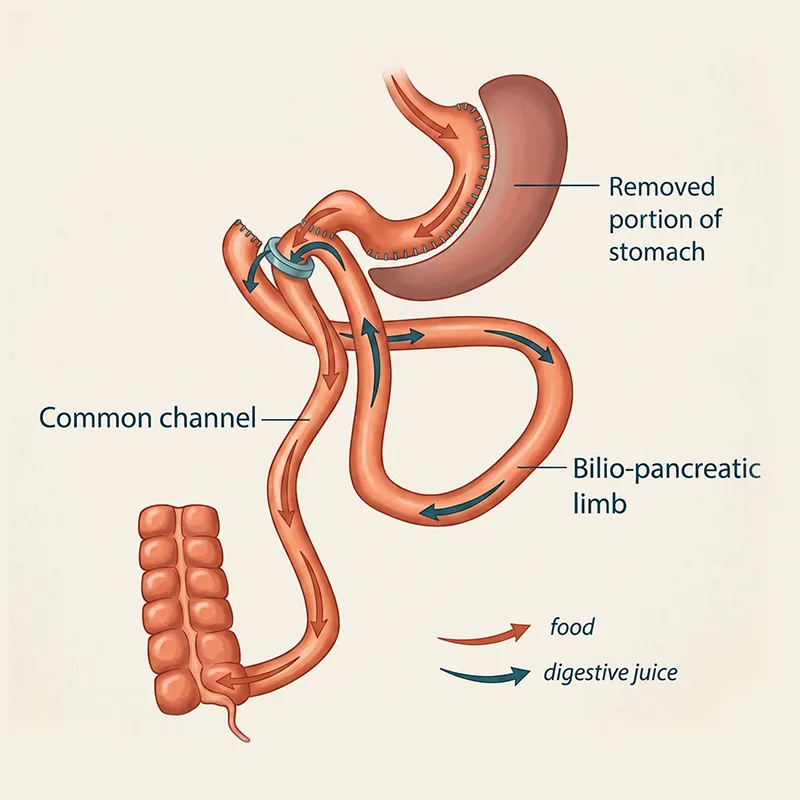
SADI surgery is a two-part procedure that first reduces the stomach to roughly 80% of its original size and then reroutes a portion of the small intestine to significantly limit calorie absorption. The result is one of the most effective weight loss procedures available. At BMI Surgery in Birmingham, Dr. Long performs SADI as a primary procedure for patients with a BMI of 50 or higher, and as a next-step option for patients who’ve had a prior sleeve but haven’t seen the results they needed.
Could SADI Surgery Be the Right Fit For You?
The honest answer starts with a consultation, but here’s a useful starting point.SADI surgery is a higher-level intervention, and that’s exactly what makes it the right choice for a specific group of patients. It’s not designed for everyone, and a good surgeon will tell you that. Here’s a general picture of who tends to be a strong candidate:
If you’re reading this and nodding along, that’s worth paying attention to. Our team will give you an honest, thorough assessment based on your full health history.
SADI surgery is just one of the many solutions we offer. If you’re still exploring your options, we provide a full range of weight loss procedures to suit your needs and goals.
The Questions Huntsville Patients Ask Us Most About SADI Surgery
SADI surgery has been performed globally since 2007 and has a growing body of clinical evidence behind it. A 2025 randomized controlled trial published in The Lancet found SADI-S to be more effective than gastric bypass at two-year follow-up in terms of total weight loss.
It was formally recognized by the American Society for Metabolic and Bariatric Surgery as a standard bariatric procedure, and multiple long-term studies have confirmed its durability and safety profile. It’s less widely known than gastric sleeve or bypass because it’s a more specialized procedure, not because the evidence isn’t there.
Both SADI and gastric bypass involve restricting stomach size and rerouting the small intestine, but the mechanics differ in a way that matters.
Gastric bypass creates two separate intestinal connections. SADI requires only one, which simplifies the surgery, reduces the risk of certain complications like bowel obstruction, and still delivers comparable weight loss outcomes.
SADI is particularly well-suited for patients with very high BMIs or those converting from a prior sleeve, where the sleeve component is already in place or can be formed as part of the same procedure.
This is one of the most important things to understand going into SADI surgery, and we’d rather you hear it clearly upfront than be caught off guard later. Because SADI affects how your body absorbs nutrients, particularly fat-soluble vitamins like A, D, E, and K, a lifelong supplement routine is non-negotiable.
Most patients also supplement calcium, iron, and zinc on an ongoing basis. The good news is that with the right routine, nutritional deficiencies are very manageable. Our team builds a personalized supplement plan with every SADI patient and monitors nutritional levels at each follow-up appointment. We also offer a curated vitamin shop specifically stocked for post-bariatric patients.
The sleeve gastrectomy component is permanent: the portion of the stomach removed cannot be restored. The intestinal rerouting can be modified if a medical need arises down the line, but SADI should be approached as a lifelong commitment rather than something to revisit.
That’s not a reason to hesitate. It’s a reason to feel confident in the consultation process. We want every patient who moves forward with SADI to do so fully informed and genuinely ready.
Most patients feel well enough for light daily activity within two to three weeks of surgery. Return to desk work or low-impact activity typically happens around that same window.
More strenuous physical activity is reintroduced gradually based on Dr. Long’s guidance, usually several weeks further out. Full recovery, the point where most patients feel like themselves again, tends to land between four and six weeks. Throughout all of it, our team is accessible and involved.
Huntsville, This Might Be the Conversation That Changes Things
If you’ve spent time researching weight loss surgery and SADI keeps coming up as the option that fits your situation, trust that instinct enough to have a real conversation about it. Dr. Long and the BMI Surgery team have guided patients through this procedure with the kind of care and transparency that makes a complex decision feel manageable. You don’t need to have everything figured out before you reach out — that’s what the consultation is for.